Mostrando entradas con la etiqueta Japanese. Mostrar todas las entradas

18 enero 2013

Hello! How are you?


Another Japanese lesson! An important one: How to introduce yourself!

First a self-introduction, it's nice to know what to say when you meet someone~

はじめまして [hajimemashite]。Nice to meet you, literally "for the first time".

私の名前は_______。[watashi-no-namae-"wa"___]My name is ______. [私 = わたし[watashi] ; 名前 = なまえ[namae]]

Or

私は_______です。[watashi-"wa"____desu] I'm ______.

よろしくお願いします。[yoroshiku-onegaishimasu] Pleasure to meet you, literally "please me kind to me".
[お願いします= おねがいします[onegaishimasu]]


There are also casual ways such as よろしく [yoroshiku] but I'd go the safe way and be polite, just in case x)


Example:

はじめまして。私はリオターです。よろしくお願いします。[hajimemashite. watashi-"wa"-riotaa-desu. yoroshiku-onegaishimasu]


Vocabulary:

こんにいちは。[konnichi"wa"] Hello
おはようございます。[ohayougozaimasu] Good morning (おはよう~ [ohayou] morning ~ casual)
こんばんは。[konban"wa"] Good afternoon
おやすみなさい。[oyasuminasai] Good night (おやすみ~ [oyasumi] g'night~ casual)
みなさん[minasan] Everybody/Everyone

元気ですか?[genki-desu-ka?] How are you? (literally "Are you healthy") (元気?[genki?] ~casual) [元気 = げんき[genki]]
元気です。[genki-desu] I'm fine (元気 [genki]~casual)
まあまあ。[maa-maa] So, so

ありがとう。 [arigatou] Thanks ~casual
ありがとうございます。[arigatou-gozaimasu] Thank You
どうもありがとうございます。[doumo-arigatou-gozaimasu] Thank You very much
お願いします。[onegaishimasu] Please (おねがい [onegai] ~casual)

すみません。[sumimasen] Excuse me
ごめんなさい[gomennasai] I'm sorry (ごめん [gomen] ~casual)

いただきます。[itadakimasu] ((before eating)) literally "I will receive"
ごちそうさま。[gochisousama] ((after eating)) ~thanking for the food~
おいしい。[oishii] delicious
かんぱい。[kanpai] cheers

もういちどお願いします。[mou-ichido-onegaishimasu] Repeat, literally "once again / one more time"
ゆっくりお願いします。[yukkuri-onegaishimasu] Slowly, please.
かいてください。[kaitekudasai] Please, write it down.

------------------------------------------------------------------------------


25 marzo 2012

Particles は and が


Hey! This is going an important post! :)


Today I'll introduce the particles  は and が. I'll try to make it simple but actually these two particles, は and が, are kinda tough for Japanese learners as sometimes it is difficult to know when to use one or another.


は is one of the Japanese particles. Although the hiragana は is pronounced "ha", when used as a particle it is pronounced as "wa".


I'm no pro explaining things but thinking that the particle は had to stick with the subject you were going to talk about helped a lot. Also there's an unsaid rule that you should only use は once per sentence. So if you've already said it once in a sentence and you want to introduce another thing in the sentence you have to use が.


Summarizing, both show what is the subject but は emphasizes what comes AFTER and が emphasizes what comes BEFORE.


Sentence pattern only using は :  A は B です。A is B.
Sentence pattern only using が :  A が B です。A is B.
Sentence pattern using は and が in the same sentence: Aは B が ______ です。


This pattern is very complicated to translate so it's better to think of it as: "As for A, B is ______".


Instead of  です, you can say other things, such as じゃありません, でした, じゃありませんでした...
が です。


Examples that I hope helps everyone understand:


私はリオターです。I am Rioter.


私がリオターです。I am Rioter. [The importance is on the "I". This could be used, for example, if some asks "Who is Rioter?", so you answer "I am Rioter." ~me, not anyone else, it's me~ ]


私は猫が好きです。 I like cats. (Or more literally: "As for me, cats are liked (by me)" Oh my... This sounds so weird D: But it's the best I can do. The more you understand the structures this way, the more Japanese-like mind you'll be able to have :)


(Yes, I used Kanji and Katakana which I haven't yet made a post about. Don't worry! :) 私 is read わたし, and リオター is read りおたあ )


And that's all! I hope I could make it easy~ ^^ See you soon


-------------------------

Today's song: Mr Children - "Hanabi"


 この歌が大好きです。(I love this song <3)

[ この = This ; 歌 (うた) = song ; 大好き (だいすき) = love] 

13 noviembre 2011

Asking Questions @_@


Hey everyone!! :D

This is just a tiny little thing, simple, but SO great! Asking questions is absolutely super important >.< AND for our luck, is SO easy in Japanese ^^

You just have to add   か at the end of the sentence... And... tadaa! You've just converted the sentence into a question :D

Pattern:     A   ですか  ?

                   "Is it A?"

Here I've set up the pattern with です because it's the verb I've learnt. You can use  か with other things, just add it up at the end ;)

example:     なし ですか?

                   "Is it a pear?"

So till the moment, we already know how to set up sentences and how to ask, that's a great improvement! ^^

Today's song: Biffy Clyro "Bubbles" ~I totally love this band *-*

06 noviembre 2011

Basic Sentence Pattern


みんなさん おはよお!(Morning, everyone!)

Today we'll learn how to make basic sentences! Isn't that great? Now we can start to speak & write :D... Only this is just a start... There's still a long way to go.

Pattern:           A   です。

                       "It is A."

A being a noun. ですcan be translated to "it is". BUT it is not pronounced "desu", it is pronounced "dess".

Example:         さる です。

                    "It is a monkey."

VERY simple but useful!! This is just our beginning in this Japanese long trip ;D

--------------------------------

Vocabulary : 
monkey - さる
grapes - ぶどう
strawberry - いちご
pumpkin - かぼちゃ
Yes - はい
pear - なし
cherry - さくらんぼ
mushroom - きのこ
peach - もも
octopus - たこ
watermelon - すいか

----------------------------------

Today's song: The Swellers "This is my Everest" ~This is our Everest, but we'll get to the top :)


24 octubre 2011

Hiragana


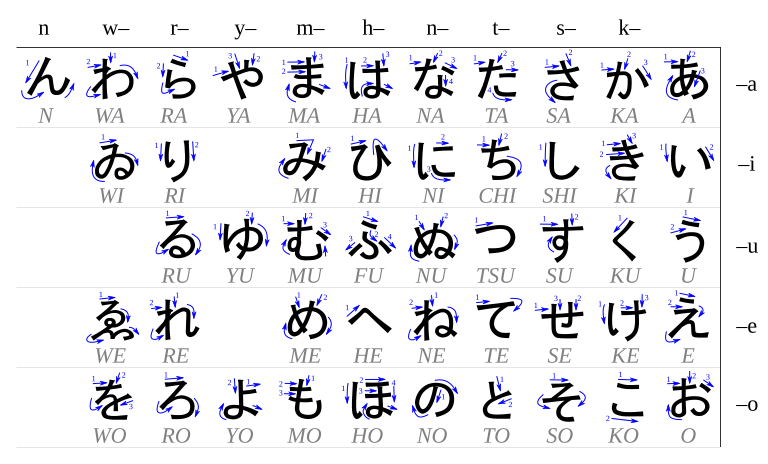
Today's topic: ひらがな (HIRAGANA)

¿Easy peasy? I do think so ;) Let's get on with it then!

 Key: Follow the pattern (a i u e o) 

[From left to right, from top to bottom]


Really bad quality pics... ò_ó mad at blogger, can't there be an intermediate size between large and extra large!? Well, sorry for that, I got this pic from Wikipedia, so there you can see it perfect.

These are the basic characters, but by adding dakuten (marks), such as ten ten (two little strokes on the top) or maru (little circle on the top) you get more sounds. 


Also there is combination hiragana: hiragana characters combined with a small やya/ゆyu/よyo  [These must be small, I just don't know how to fully use IME very well...] 


Also to write doubled consonants, before the consonant you write a small  つtsu [This must be small too...]
Here are examples so you understand, as today I'm not explaining myself very well...
Cafe: きっさてん (kissaten) /// Stamp: きって (kitte)

That's it with hiragana, just learn them. The pronunciation of hiragana is basically "Spanish-like" sounds. There are zillions of videos on Youtube ;D

Enjoy learning hiragana, it's fun and rewarding!!

Today's song: Yui Horie (& Unscandal) "Scramble" ~Very Positive! Because we are both happy now we know ひらがな , it's a very big step on our Japanese ^^


13 octubre 2011

First Contact


みんなん こんにちわ!(Hello everyone!) 
A few months ago I started seriously my Japanese learning project. My goal is not only being able to speak (fluently, hard goal haha) but also being able to read and write Japanese. Sounds tough, huh? 

So the first thing to ask ourselves is: In what is Japanese written? 
English is written using an alphabet, we all know that, you combine letters (26 to be precise...) to make words. Japanese language doesn't have an alphabet as such, instead it has 4 "alphabets". They're not actually alphabets, of course, but the general idea is that. Those 4 writting systems are: Romaji, hiragana, katakana and kanji.

Romaji is just the romanization of the Japanese proper writing systems. In other words, writing Japanese with the English alphabet. This is not accurate and should not be read with the English pronunciation (quite obvious...). So it's reasonable to think that this "alphabet" isn't very useful, 99% of the time you won't see romaji on real life Japanese, therefore it's a less waste of time to focus on the other 3 ;)

Hiragana is the base of Japanese. Technically it's a syllabary that contains 48 characters (but some of them combined and some of them with a "dakuten" makes them a few more). Learning it makes you achieve more and better :D By knowing it you can start right away reading Japanese (although you won't understand much as you lack grammar and vocabulary). Each character is made up of two English letters, presicely a vowel + consonant. Exceptions: single "n", those that are consonant + ya/yu/yo. For me hiragana is fun to learn, so cute and rounded :3

Katakana has the same characters as hiragana with the diference that katakana is sqared and edgy. Also Katakana is used to write foreign words and onomatopeya. That's the main diference: Hiragana, Japanese words, katakana, foreign words and sounds.

Kanji are the chinese characters. Those big and full of strokes unreadeable smudges on the paper. Hopefully I'll get round it too. I'll beat you kanji! Wahahaha! (Ok... I got too overly exited xD). Kanji was imported to Japan several times (that's why some kanji have more than one reading!). Kanji has on-yomi and kun-yomi. In other words, Chinese reading (on-yomi) and Japanese reading (kun-yomi). Some Kanji have multiple on readings and multiple kun readings, but I am following a kanji learning method that feels pretty good and focused on the 90% time readings used :). Therefore I don't waste my time and memory space in learning readings that are never used :D. All the vocabulary words can be (and mostly are...) written with kanji. There are +10000 kanji but luckily the Japanese Government has set up a list (Jōyō Kanji with 2,136 characters) with the most used kanji (not only most used but the only that are used). Rarely you will see kanji in real life (newspapers, etc) that aren't included on the list (rarely, not never ). Let's be optimistic about it!

These are the very basic ideas for today. I'll keep on going with my Japanese and telling you about it. Therefore I take in things better by writing here.

Today's song: Toe "Good Bye" So relaxing~